In partnership with


Did you know that we have LinkedIn, Instagram and X accounts
that you can follow?


Hi {{first_name|everyone}},
Anthropic is letting Claude approve routine code changes on its own, and the team writing the rules decides how far that goes. Here's what's in today's issue:
How Claude Ship reviews, fixes, and approves code, and who sets the limits
A Rust project an AI agent built that matches CPython's output almost exactly
A plain-English look at OCR
A few fresh tools worth trying out
Twelve AI agents rebuilding a famous San Francisco landmark in 3D
A quick share from our friends asking whether 390 U.S. metro regions can outrun the economic danger of corporate AI
Okay, that's enough from me. Time to start reading.
🤿 DEEP DIVE

Image credit: Anthropic
When Claude Gets to Approve Code
Developers write the rules, Claude handles routine approvals.
Claude apparently writes most of the code for Anthropic's own Claude Code team. And while that helps the team write code faster, someone still has to review all those changes, deal with any problems, and approve them.
On Monday, Anthropic introduced Claude Ship, a collection of AI agents built to handle that work.
AI reviewing code isn't particularly new. What Anthropic is doing here is giving Claude permission to approve routine code changes without waiting for a person to sign off on each one.
How the three tools work together
Claude Ship consists of three tools.
Code Review checks proposed code changes for problems.
PR Steward handles failed automated checks, conflicting code changes, and feedback from Code Review. It leaves a comment explaining what it changed and how to undo those changes.
Claude Approvals checks whether the proposed changes meet the team's approval requirements.
With these three tools, Claude can review a proposed change, work on fixing any issues, and assess whether it meets the team's conditions for approval.
Who decides what Claude can approve?
The development team writes its own approval policy in plain language and stores it in a file alongside the code.
Claude follows that policy when deciding whether to approve a change. The team also specifies which changes still need a human decision.
Anthropic suggests starting with something called observe-only mode. Basically, teams get to see which changes Claude would approve without giving it actual permission to approve them yet.
They can start with a single code repository, choose how thoroughly Claude reviews the code, and set monthly spending limits.
Claude Ship is rolling out to Team and Enterprise customers using GitHub. Code Review is already generally available, while PR Steward and Claude Approvals are still in beta.
The quick take
Faster AI-assisted coding is creating more work for the people reviewing it.
Claude Ship covers code reviews, fixes, and routine approvals.
Development teams decide what Claude is allowed to approve.
Observe-only mode lets teams test Claude's approval decisions without acting on them.
PR Steward and Claude Approvals are still in beta.
🤝 FROM OUR FRIENDS
A quick share we thought you might find useful
Can 390 U. S. metro regions outrun the economic danger of corporate AI?

Rebellion to Tyrants Is Obedience to God: Ending the Danger of the Corporate AI Surveillance Machine, explains how metro economic regions must continually create economic growth in order to outrun the dangers of corporate AI.
She argues that metro regions must create new technologies, industry supply chains, new ventures, and skilled workers faster than AI can erase native regional economic advantages.
The policy goal of regional AI regulation is aimed at increasing the prosperity of citizens who live in the region.
Discover how metropolitan regions and technology entrepreneurs can become the catalyst of continuous innovation and regional economic growth, that will outrun the dangers of AI.
🔥 WHAT’S THE BUZZ
What people are building, sharing, and talking about
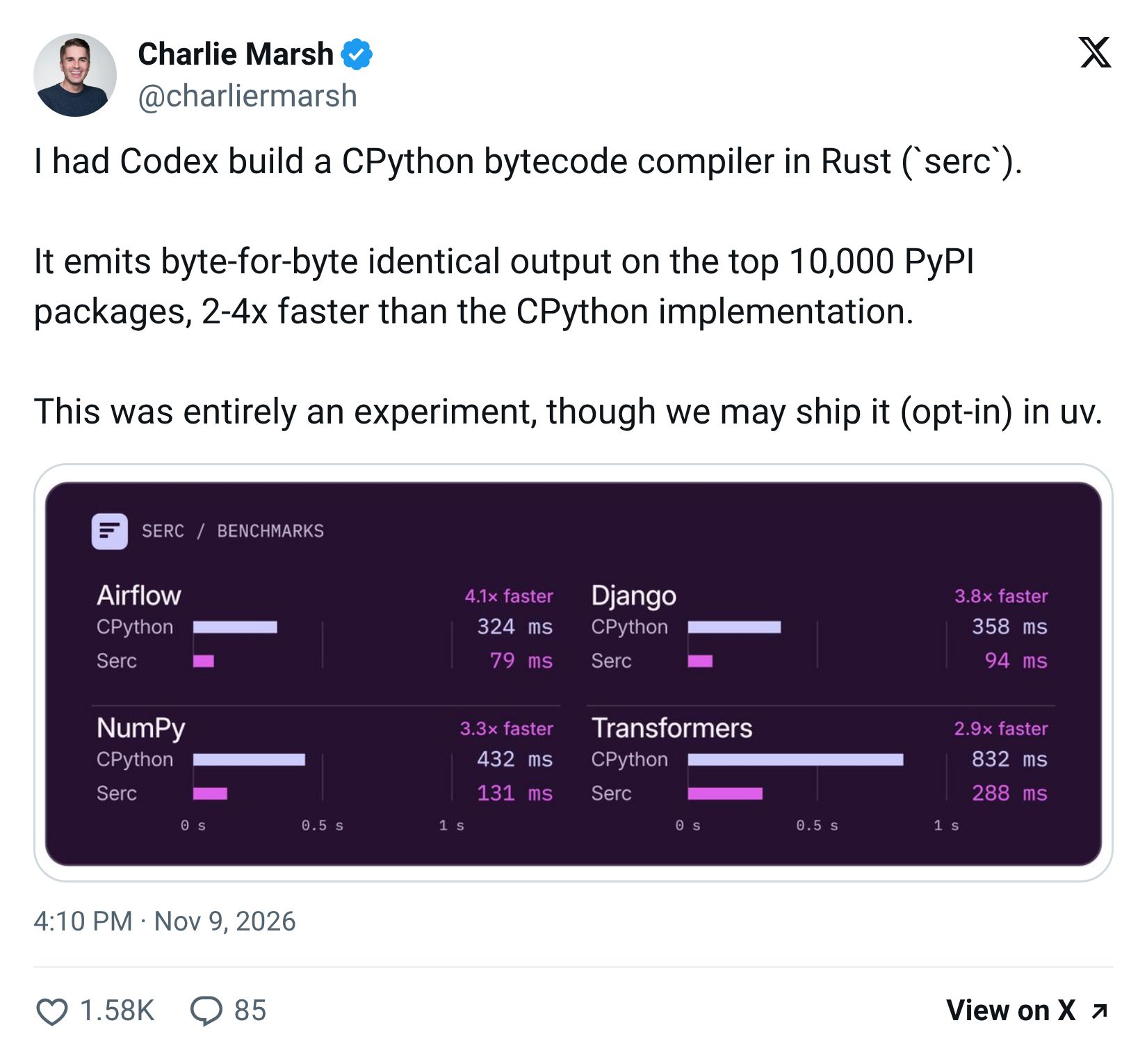
Charlie Marsh had Codex build serc, an experimental CPython bytecode compiler written in Rust. According to Marsh and the project repository, it produces byte-for-byte identical output to CPython across the top 10,000 PyPI packages while compiling several large projects roughly 3 - 4× faster. Marsh says the experiment was agent-authored, with only the README edited by a human.
This shows where agent-assisted work becomes more interesting than “AI writes code faster.” If an agent can reproduce a mature system against a reliable reference, some migration, modernization and performance work could become much cheaper. The catch is that someone still needs a trustworthy way to prove the replacement behaves correctly.
⏱️ 1-MINUTE BREAKDOWN
Tech and AI terms explained in plain English
What is OCR (Optical Character Recognition)
Technology that turns text in a photograph or scanned document into text a computer can search, copy, or edit. It saves you from having to type everything out yourself.

Example: A colleague sends you a photo of a printed meeting agenda. You need the agenda in a Word document, but you cannot select the words in the photo. An OCR tool reads those words and converts them into text you can copy. You then check for mistakes before using it.
⚒ TOOL SNAPSHOTS
Futuristic tools within AI, no-code, and productivity
🧩 Granular
Coordinate AI agents to build apps, designs, or videos.
Why it’s useful
You can check live previews as work takes shape, while keeping each project's files and context in one workspace.🐶 SuperTranslator
Understand what your dog might be communicating through their behavior.
Why it’s useful
When a bark is hard to interpret, it considers body language and interactions with surroundings too, rather than relying on sound alone.🧠 Inkling 2 Mini
Run local agent workflows on 32GB Macs through Ollama.
Why it’s useful
Its middle layers run three times per token, adding reasoning depth without extra model weights to fit into memory.
👀 ON OUR RADAR
One more thing we thought you'd like
The Future of Creator Partnerships. Straight From the Creators.

This report delivers the insights you need to build creator relationships that last.
What 300+ creators say drives successful, long-term brand partnerships
How to build trust from first contact to full commitment
What creative freedom actually looks like to the creators
🤖 AI MADE THIS
Interesting and inspiring creations made with AI
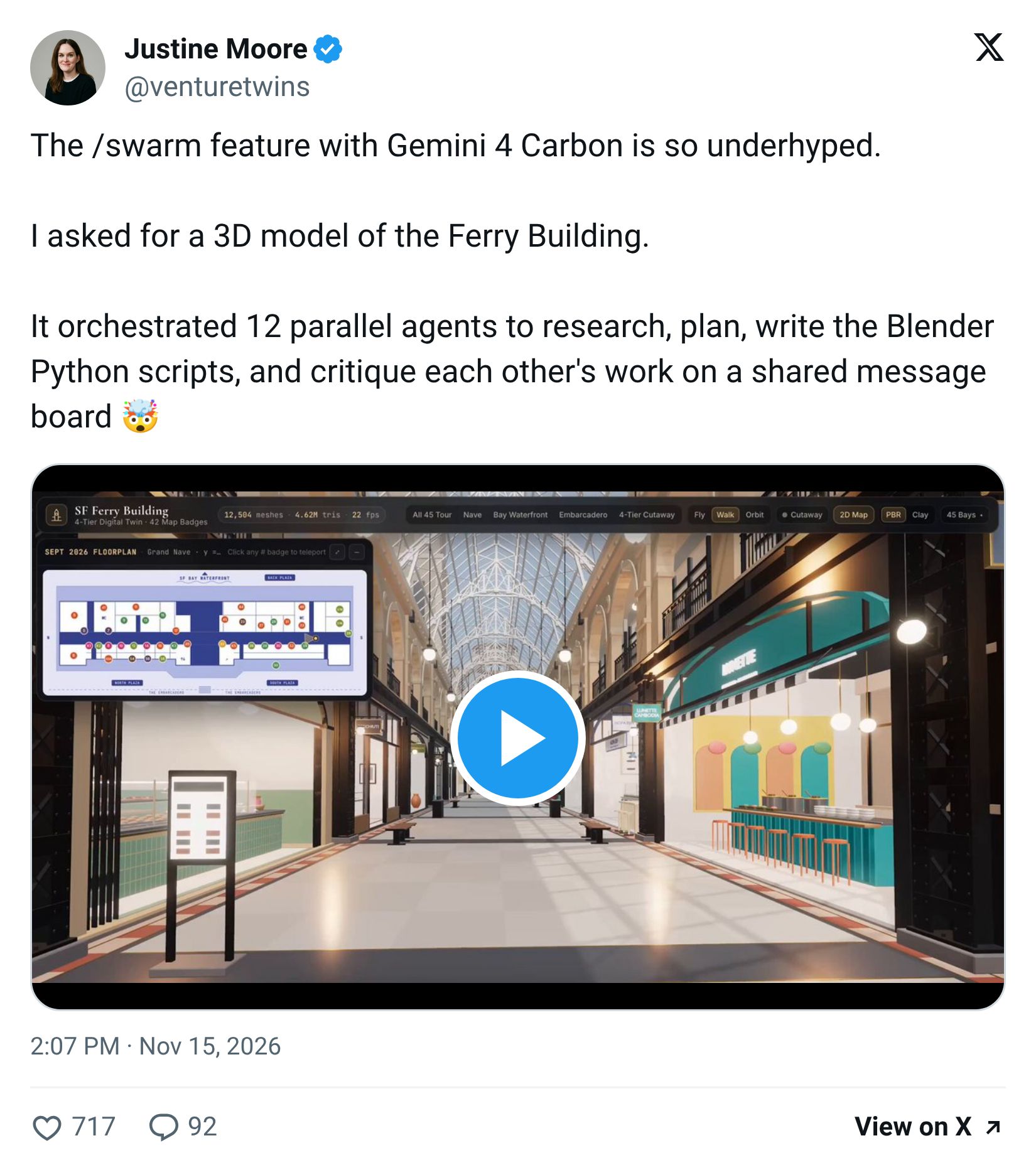
12 AI Agents Recreate San Francisco's Ferry Building in 3D
Justine Moore used Gemini 4 Carbon to coordinate 12 AI agents in recreating San Francisco's Ferry Building as a detailed 3D model. The agents helped research the architecture and write Blender scripts to construct the scene. It's a clever example of AI agents working together on something much more visual than an ordinary coding task.
AI used
Gemini 4 Carbon, with its /swarm capability explicitly credited by Moore.
AI contributed to research, planning, and procedural 3D modeling through code.
ℹ️ ABOUT US
The Intelligent Worker helps you to be more productive at work with AI, automation, no-code, and other technologies.
We like real, practical, and tangible use-cases and hate hand-wavy, theoretical, and abstract concepts that don’t drive real-world outcomes.
Our mission is to empower individuals, boost their productivity, and future-proof their careers.
We read all your comments - please provide your feedback!
Did you like today's email?
What more do you want to see in this newsletter?

